Early Years Curriculum
Intent
At Our Lady School, our intent for the Early Years Foundation Stage is to ensure that every child leaves with a secure foundation for learning that smoothly transitions into the National Curriculum. We value and build upon each child’s prior knowledge and experiences, carefully developing their vocabulary and understanding to support their next steps. Our Nursery and Reception classes work closely together to provide continuity and consistency across the Foundation Stage, ensuring a seamless transition between year groups.
Guided by our mission statement, “We learn to love and love to learn with Jesus,” we place a strong emphasis on nurturing the whole child—academically, spiritually, and morally. Our mission encourages us to create a caring and inclusive environment where children develop kindness, respect, and empathy, reflecting Catholic values in their everyday interactions.
We strive to nurture confidence, independence, and a lifelong love of learning through engaging play and meaningful experiences. This approach prepares and motivates children to progress confidently into Year 1 and beyond.
Implementation
At Our Lady, children have access to a balanced curriculum that encourages them to learn through play, actively create and learn, and think critically. Each day, children experience an exciting and varied timetable, with a careful balance between independent exploration through play and focused activities planned and led by adults. Through observation and shared play opportunities, adults are able to plan and support the children’s next steps in their learning journey.
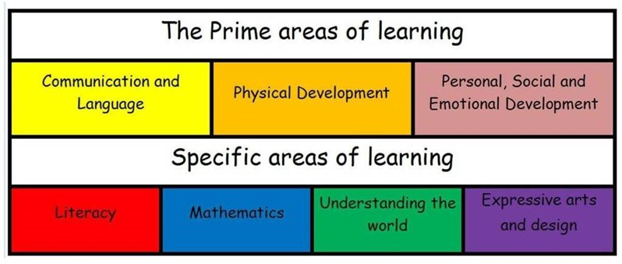
The Early Years Foundation Stage is divided into three prime areas and four specific areas. All areas of learning and development are important and interconnected. Three areas are particularly crucial for igniting children’s curiosity and enthusiasm for learning, and for building their capacity to learn, form relationships, and thrive. These three areas are the prime areas. Adults also support children in four specific areas, through which the three prime areas are strengthened and applied.
One of our key drivers for early literacy is Drawing Club, which captivates children’s imagination through storytelling, illustration, and shared narrative. It brings together vocabulary, creativity, mark-making, and oracy in a joyful, inclusive experience. It supports children in developing a love of stories, confidence in language, and early writing skills in a way that is both accessible and inspiring.
In addition, we implement the Little Wandle phonics programme to ensure that children develop secure early reading and writing skills. Phonics is taught daily through systematic sessions that engage and motivate all learners. We regularly assess progress and swiftly address any gaps in learning. This structured approach enables children to decode confidently, develop fluency, and build a strong foundation for a lifelong love of reading.
In mathematics, we follow the Mastering Number scheme, ensuring a clear, well-structured progression in number, shape, space, and measure. Our maths provision is practical, engaging, and contextualised, allowing children to explore concepts through meaningful play and adult-led sessions. Continuous provision further supports mathematical thinking through embedded routines, problem-solving, and rich questioning.
Our indoor and outdoor environments are rich in language, engaging, and thoughtfully designed to nurture independence, curiosity, and collaboration. We create an environment where children feel empowered to explore, take risks, persevere through challenges, and reflect on their learning. High-quality resources and open-ended opportunities inspire deep thinking and meaningful exploration. Practitioners use regular observations and ongoing formative assessments to identify next steps and adapt provision to meet each child’s evolving needs.
Throughout their time in EYFS, we support children in developing a strong sense of belonging to our Catholic school family and community. We place great emphasis on values education, daily prayer, and collective worship, helping children grow spiritually and understand how to live out the teachings of the Gospel in their daily lives.
We work in close partnership with parents and carers, recognising them as their child's first and most important educators. Regular communication and shared learning experiences ensure a strong home–school partnership, which reinforces and extends learning beyond the classroom.
Impact
At Our Lady, children in our EYFS demonstrate high levels of engagement in their learning. They are exposed to a wide range of vocabulary and develop the skills to communicate effectively with other children and adults. Children demonstrate an enjoyment of learning and develop a broad understanding of the world around them. They actively ask questions about the world and their learning experiences.
At the end of the EYFS, children are assessed using the Early Learning Goals, which measure whether they have met a Good Level of Development. We expect all children to achieve age-related expectations or to have made good progress from their individual starting points. Children leave the EYFS stage and transition to Year 1 with the skills, knowledge, and experiences needed to reach and exceed their unique potential in Key Stage 1. Our EYFS provision ensures every child has the strongest foundations for continued success and a lifelong love of learning.